
 By Asian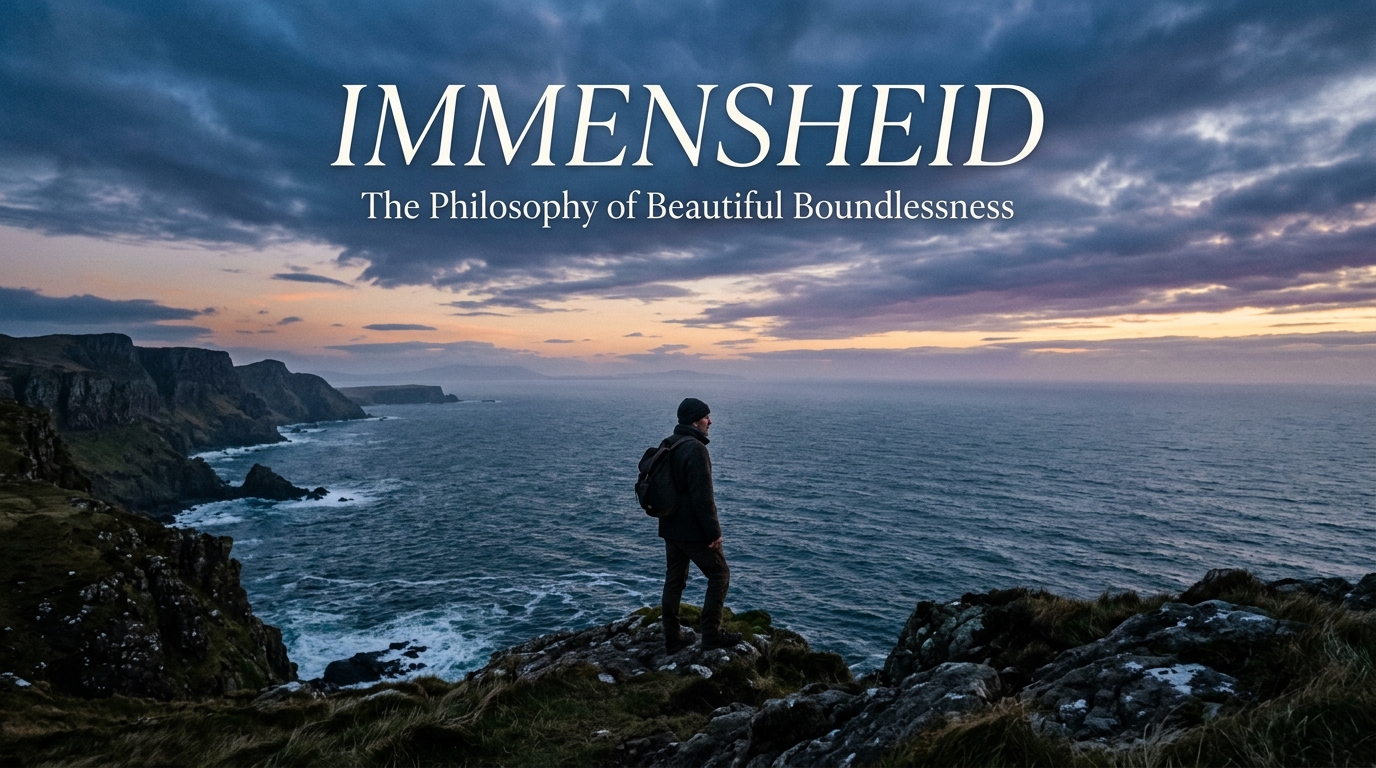
In an age where human life is increasingly quantified, scheduled, and confined within digital grids and urban corridors, a quiet psychological hunger has emerged: the longing for Immensheid. This Dutch-derived concept (closely related to the German Unermesslichkeit) does not have a single English equivalent. “Vastness” is too cold. “Boundlessness” is too literal. “Immensity” lacks the emotional resonance.
Immensheid is the felt experience of profound, beautiful limitlessness. It is the specific emotional cocktail of awe, humility, and liberation you feel when standing before a desert at midnight, sailing into a foggy ocean, or gazing at a star cluster billions of light-years away. Unlike mere size, Immensheid is a subjective state: a room can feel immensely large if it holds a lifetime of silence; a galaxy can feel small if you are indifferent.
This article explores Immensheid as a psychological, philosophical, and aesthetic tool—a way to reclaim wonder in a world of shrinking attention spans.
The Etymology of Immensheid: A Linguistic Journey
Thus, Immensheid literally translates to: “The state or quality of being not measurable.”
Crucially, where English “immensity” is a noun describing an object’s property (the ocean’s immensity), Immensheid is a personal condition (the sailor’s immensheid). It is not a property of the thing you see, but of the relationship between you and the thing. You enter Immensheid; you do not simply observe it.
The Four Pillars of Immensheid
Immensheid rests on four distinct but overlapping domains. A single experience can involve one or all.
Spatial Infinity (The Outer World)
This is the most obvious pillar: vast physical space with no visible boundary.
-
Examples: The Grand Canyon, the Patagonian steppe, the Arctic ice sheet.
-
Psychological effect: Proprioceptive recalibration – your body’s sense of its own size temporarily dissolves. You feel small, but not insignificant. In healthy Immensheid, “small” equals “free.”
Emotional Depth (The Inner World)
Some feelings are so complex and profound that they feel infinitely deep.
-
Examples: Grief after a permanent loss, romantic love in its 20th year, the sudden memory of a dead parent’s voice.
-
Psychological effect: Time seems to stop. You realize the emotion has no floor; it extends downward forever. This is not depression. It is the recognition that your inner life is an ocean, not a puddle.
Temporal Boundlessness (The Eternal Now)
This pillar occurs when your perception of past, present, and future collapses into a single, endless present.
-
Examples: Listening to a 40-minute ambient drone piece, watching a slow sunrise, meditating for hours without checking a clock.
-
Psychological effect: Chronoception distortion – you stop measuring time by clicks and begin measuring it by breaths.
Intellectual Horizon (The Unknowable)
The most abstract pillar: the awareness that there are true things you will never understand.
-
Examples: Contemplating the size of Graham’s number (a mathematical integer so large the universe cannot contain its digits), trying to imagine a color you’ve never seen, or thinking about what happened before the Big Bang.
-
Psychological effect: Cognitive humility – a productive surrender. You stop trying to master reality and start appreciating its mystery.
Immensheid vs. The Sublime: A Critical Comparison
Many thinkers confuse Immensheid with the 18th-century philosophical concept of the Sublime (Edmund Burke, Immanuel Kant). They are cousins, but not twins.
Key takeaway: The Sublime says, “I am terrified, but my mind survives.” Immensheid says, “I am tiny, and that is exactly the right size.”
How to Cultivate Immensheid in Daily Life
Immensheid is not reserved for mountaintops. You can build “micro-immensheid” into a Tuesday afternoon.
The 10-Minute Sky Protocol
-
Go outside. Look at the sky (day or night). Do not look for clouds, planes, or stars. Look at the empty space itself. For 10 minutes, repeat internally: “There is no roof.”
Distant Sound Listening
-
At night, open a window. Listen for the faintest possible sound—a distant train, a neighbor’s dog, wind three streets away. Track the sound until you feel the space behind it. That infinite regression is acoustic Immensheid.
Reverse Zoom
-
Open a map app. Zoom in on your house. Then slowly zoom out: neighborhood → city → country → continent → planet → Earth from space. Pause at each level for 20 seconds. Feel the multiple nested immensities.
The One-Breath Horizon
-
When walking in any open area (park, parking lot, beach), take a single deep breath. On the exhale, imagine your breath expanding to fill the entire visible horizon. Do not hurry to the next breath.
The Dark Side of the Vast: When Immensheid Overwhelms
Not all boundlessness is beneficial. Immensheid has a pathological twin called Apeirophobia (fear of infinity) or existential vertigo.
Symptoms of Toxic Immensheid:
-
Derealization: The world feels fake because it is too large to be real.
-
The Pale Blue Dot Paradox: Instead of feeling wonder at Earth’s smallness, you feel total nihilism (“Nothing I do matters, so why act?”).
-
Spatial Panic: Open fields or high ceilings trigger anxiety, not calm.
The Cure: Anchor yourself in the small. After gazing at the cosmos, touch a piece of wood. After contemplating geological time, drink a glass of water. Healthy Immensheid always returns you to the finite. The goal is not to live in the infinite—that is madness. The goal is to visit the infinite and bring back a sense of proportion.
Conclusion:
Immensheid is not a destination; it is a way of seeing. In a culture obsessed with metrics—steps taken, hours logged, dollars earned—the concept of “unmeasurable-ness” is quietly revolutionary. To say “this moment has Immensheid” is to say, “I refuse to reduce this experience to a number.”
The four pillars (space, emotion, time, intellect) remind us that vastness exists in every direction: outward, inward, forward, and upward. You do not need to fly to space or climb a mountain. You can find Immensheid in the pause between two heartbeats, in the silence after a piano note fades, or in the honest admission that you do not—and will never—know everything.
Live not in the prison of the small. Live not in the chaos of the infinite. Live instead in the fertile tension of Immensheid: awake, tiny, and entirely free.
FAQs
Is Immensheid the same as “awe”?
No. Awe is often triggered by vastness, but awe includes an element of surprise or admiration for a specific object (a waterfall, a cathedral). Immensheid is the background condition of boundlessness itself. You can feel Immensheid without a specific trigger.
Can you feel Immensheid indoors?
Absolutely. A vast, silent library, an empty cathedral, or a dark room with a single candle can all produce Immensheid. The key is perceived limitlessness, not literal square footage.
Is Immensheid a religious experience?
Not necessarily. Religious people might interpret Immensheid as contact with God. Atheists might interpret it as contact with the cosmos. The feeling itself is pre-religious; it’s a neuropsychological state that different cultures then label.
How is Immensheid different from the “flow state” (Csikszentmihalyi)?
Flow is about action (losing yourself in a task like painting or climbing). Immensheid is about reception (losing yourself in a state of being). Flow is active; Immensheid is contemplative.
Can technology induce Immensheid?
Yes, but carefully. VR simulations of deep space or 360° ocean footage can trigger a shallow version. However, real Immensheid usually requires risk, discomfort, or silence—things technology tends to filter out.